


© 1998-
















One of the more tedious and time consuming jobs in a "from-
The three most common ways that the nuts, bolts, and screws that were used on our Falcons were originally protected from rust and corrosion are; 1) chrome plating, 2) zinc or silver cad plating, or, 3) black oxide finishing. In addition, a few fasteners on these cars were made of stainless steel and required no plating or other finishes. It is possible for fasteners to be stripped and painted or powder coated, but the finish is easily damaged on the heads of bolts, nuts, and screws during the tightening process and the finish on the threads will definitely be damaged during tightening as well. This renders the fasteners easily susceptible to rust and corrosion, and lends a look of overall poor appearance. These problems occur far less with chrome, zinc/silver cad, or black oxide coatings since the coating is either electrically or chemically bonded to the surface of the part, or, as is the case in black oxide finishes, the finish is actually part of the part. All of these finishes are far tougher than paint or powder coatings as far as fasteners are concerned.
If your fasteners are moderately damaged or worse then you really have no choice other than to replace them with whatever you can find that will do the job. This is especially true if the threads are physically damaged or are moderately to badly rusted. Condition of the threads of nuts and bolts is critical to the performance of the fastener. If the fasteners are used for any type of structural connection the threads must be strong enough not only to tighten properly, but also to hold that part in place while under stress. Threads that are even just lightly to moderately rusted have already lost a great deal of their ability to tighten properly without stripping loose, let alone also hold a part under stress. Such deteriorated fasteners should never be used in any type of structural connection, but they can be used in nonstructural applications, such as attaching decorative trim, as long as there is enough thread left to tighten the fastener enough so it will not come loose. If, after careful inspection, you find that the fasteners are undamaged or only have minor damage, and/or have only surface rust, they can be restored to good as new condition.
Restoration Options
The word restoration means to return something to a state it was once in from a state
it is in now. When fully restoring a 35 to 40 year-
Another area of concern is physical damage to these fasteners. Some damage occurs from the fastener being struck by something else, such as a bolt on the undercarriage being damaged from the car bottoming out on speed bumps or pot holes over the years. Other damage comes from less than optimal maintenance practices over the years such as using channel locks to remove a bolt or nut rather than using the correct size socket or wrench. Common damages as these include the stripping of phillips head screws by using the wrong size screwdriver, cross threading or over tightening bolts & nuts thus damaging or stripping the threads, using a hammer to force a bolt into a tight hole thus damaging the threads, etc.
If you need or desire to reuse a particular fastener, inspect it carefully to assess
what if any damage you will need to correct before restoring the proper finish. Light
damage to threads can be repaired with a thread restorer. A thread restorer is designed
to "push" threads back up to their original position when they have been mashed down
flat (such as if the threads had been hit with a hammer, thus flattening the raised
threads). In this instance, a thread restorer should be used instead of a thread
cutting device such as a tap or die since these will simply cut away the flattened
portion of the threads, rather than restore them to their original height. One problem
with a thread restorer though is that of fatigue hardening. All of us have bent a
piece of sheet metal back and forth till it eventually breaks. This happens because
metal, when it is stretched, hardens and becomes less elastic making it more brittle.
When threads have been bent down once, and then bent again back to original position,
they have lost flexibility and become more brittle, thus they have lost some of their
strength. Before restoring damaged threads consider both the amount of thread damage
and the application the fastener will be used in. In a critical area such as head
or rod bolts in an engine, restoring damaged threads is not a sound practice, while
using this method on one of several bolts that holds on a fender would probably be
fine. Often, if threads are damaged, it is best to replace the fastener if possible.
Light damage to the head of nuts and bolts can be repaired with light grinding or
filing to remove rough or sharp edges. If the head is damaged such that you will
not be able to tighten the fastener properly then attempting to restore it is fruitless.
Rust and corrosion can ruin threads, the un-
Once all the physical damages have been repaired, it is time to consider restoration of the correct or original finish to the fastener. Let's take a look at the different fasteners used on Falcons and the restoration considerations for each.
Stainless Steel: These fasteners generally are very durable and most often do not
need to be replaced. Usually they can simply be cleaned up and reused. They can even
be buffed up to a chrome-
Chrome Plated: Chrome plating is a very durable, long lasting finish. If you have
fasteners that were originally chrome plated, you can simply buy new ones or have
the harder to find ones re-
Zinc/Silver Cad Plated: Zinc plating is an economical and fairly durable finish,
however it is not nearly as durable or attractive as chrome. These fasteners are
commonly available and almost any type and size of zinc/silver cad plated fastener
can be located. There are, however, vast differences in the quality of these fasteners
and the plating on them so expect to pay more for suitable quality. Lesser quality
fasteners will dull and rust far sooner than higher quality ones. If you cannot find
a fastener to replace yours with, zinc plating kits are available for use in your
home shop. For example, Eastwood offers a tin-
Black Oxide: Black oxide is a fairly durable, but not dressy finish. The finish is not applied to the surface of the metal as with chrome or zinc plating. Instead, the surface of the bare metal is brought into contact with a solution that causes a relatively stable oxide to form in the upper layers of the metal part. Thus, the finish is actually "part" of the part, and it forms a hard, durable surface on the part. Nevertheless, it must be noted that black oxide is still an oxide, just as is rust. Even though black oxide is more stable than regular old rust, it still needs some sort of sealer to keep moisture from seeping beneath the exterior oxidization and starting new rust below. Even so, this process is far prefered to simply painting or powder coating nuts, bolts, and screws. None of the black oxide fasteners I removed from the car were still looking good. All had some level of rust, some had bad physical damage, and others were rusted beyond reuse. I replaced all the black oxide fasteners I could. Where these fasteners were damaged beyond reuse and I couldn't find exact replacements, I went with the closest match I could find. There were, however, quite a few of these fasteners that were still in generally good condition, and which I was having a difficult time finding proper replacements for. As a result I decided to purchase Eastwood's "Blackening System" to refurbish them. The system costs around $30 and its use will be discussed in part two of this edition.
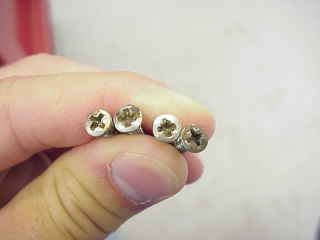
This is an example of physical damage to heads of phillips screws. These screws came from the chrome trim around the windshield and are chrome plated steel.
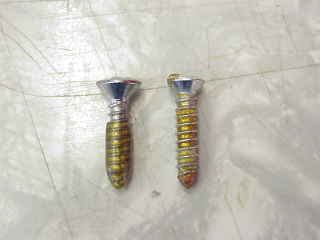
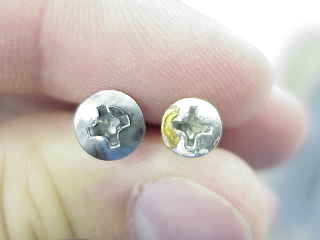
The new screw on the left in the photos above is a new chrome plated steel screw with a wax sealer on the threads. The screw on the right was removed from the stainless steel and chrome trim around the windshield. It originally looked to me as if the threads had rusted, but after seeing the screw on the left, and making a closer inspection, I realized the screw had originally had a sealer on the threads just as the one on the left. The sealer was used to seal the hole in the windshield frame so that rain/wash water would not get into the frame and rust it. Unfortunately, the head on this new screw is too large for the application, otherwise it would have been an excellent, exact replacement.
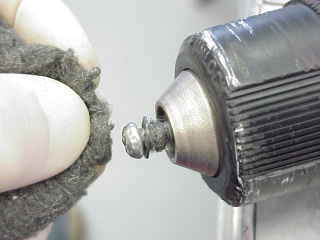
Many screw heads can be polished to restore luster and shine. One method is to use a metal polish. Another is to use steel wool to buff it. I used a drill for the buffing process. I gently tightened the threaded portion of the screw in the chuck (just tight enough to hold it but loose enough so the threads are not damaged) and then ran the drill while gently pushing "0000" steel wool on the face of the screw head till a good shine is restored.
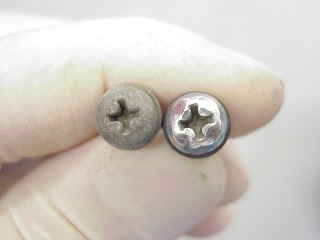
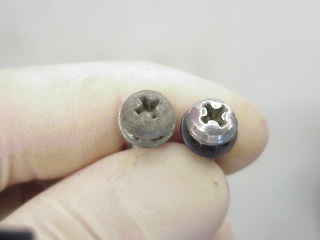
These screws hold the convertible top latching brackets. The screw on the left has
is as removed from the car. The one on the right has been buffed with steel wool
and a drill as previously shown. The color tint on the polished screw heads are a
combination of reflection and artifacts from JPEG compression-
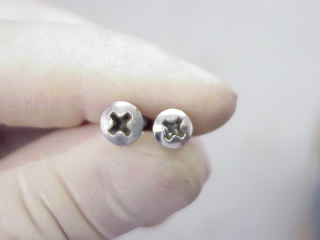
Another comparison: These screws are chrome plated steel. The one on the right has
been buffed with steel wool. I twisted some strands of the steel wool into a thread-
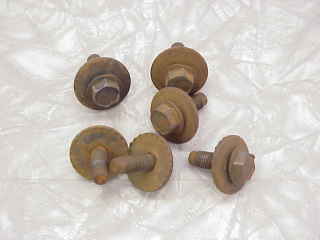
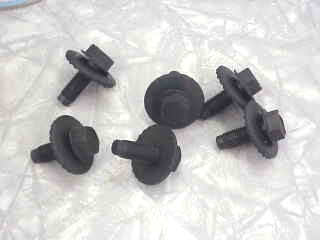
These are bolts for the structural cross member under the transmission that is only used on convertibles. A couple of the heads had received minor physical damage over the years but the threads were in excellent condition. After filing off rough edges on the heads and and media blasting the rust away these bolts were refinished with Eastwood's blackening system (using Eastwood's blackening system is covered in part two of this edition). The left photo shows them after being degreased with solvent and dried with compressed air. The right photo is after the process is complete.
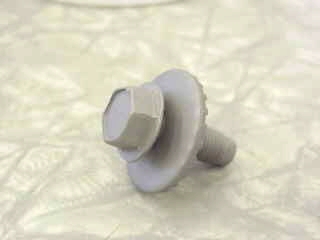
This is what fasteners look like after media blasting. With all the protective finish removed they obviously need to be finished with some sort protective finish or they will begin rusting almost immediately, even from just the humidity in the air.
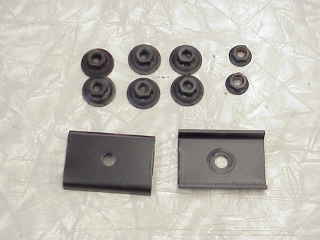
These nuts and brackets are used to secure the front bucket seats in place and are installed from the undercarriage after the seats are in place. The nuts were given a black oxide coat. The brackets were primed and painted, but they could also have been given a black oxide coat quite easily. However, since the brackets do not receive the same stresses that nuts & bolts do during tightening, paint or powder coat is probably the best choice for durability.
Overview
Discussion & Procedure
Restoring Nuts
Bolts & Fasteners
Part 1
This is the end of the Restoring Nuts, Bolts, & Fasteners Edition Part 1
Part 1


Feel free to save this page to your computer for your personal use and future reference-
If you have comments or suggestions, email me at joe@joesfalcon.com
